Benchmarks / BrowseComp
BrowseComp
Built by OpenAI · Jason Wei, Zhiqing Sun, Spencer Papay, Scott McKinney, et al. · released Apr 2025
1,266 hard fact-finding questions with short, single answers. Each answer is hard to find but easy to verify, so a browsing agent must search persistently and combine clues from many sites.
Frontier
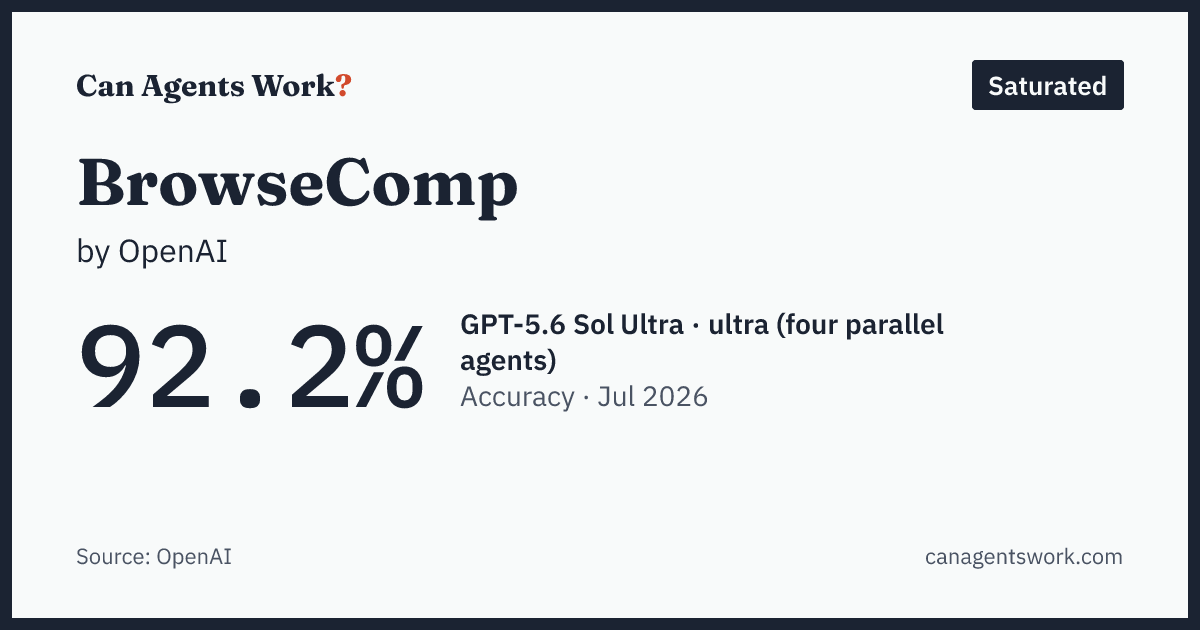
92.2%
Accuracy
GPT-5.6 Sol Ultra · harness: ultra (four parallel agents)
Jul 2026 · Source: OpenAI (benchmark maintainers)
GPT-5.6 launch post. "Ultra" coordinates four agents in parallel by default. GPT-5.6 Sol without Ultra scored 90.4% in the same table. OpenAI is both the benchmark maintainer and the model developer.
The best result is at 90% or more of the ceiling.
What it measures
Share of questions answered correctly. Human trainers wrote "inverted" questions from a seed fact and several constraints (for example, find a paper by the authors' universities and venue). Every question was checked to be unsolvable by GPT-4o, o1, and an early deep research model at the time, and not findable on the first page of five simple searches. Grading compares the short answer with the reference.
Accuracy: Share of the 1,266 questions answered correctly. Higher is better.
Status compares the frontier with a ceiling of 100%.
Facts
- Grain
- Task level: bounded tasks with a clear spec
- Environment
- browser
- Grading
- automated-tests
- Tasks
- 1,266
- Human reference
- Trainers who did not write the question solved 29.2% of problems within a two-hour limit and without AI help. Of solved problems, 86.4% matched the reference answer.
- Contamination
- Questions and answers are public in the simple-evals repository, so later models may have trained on them. OpenAI has not published a contamination analysis.
- Reuse
- Released in OpenAI's simple-evals repository, which lists BrowseComp under the MIT License. (open-mit)
Limits to keep in mind
- Answers are short strings, so the benchmark does not test long answers, ambiguity, or real user queries. OpenAI calls it an incomplete but useful measure of browsing. Source
- OpenAI builds the benchmark and reports its own models. Later scores come from OpenAI launch posts, and the top score uses four agents running in parallel. Source
- The best scores are now above 90%, so the benchmark is close to saturation. Source
- Deep Research, the launch leader, was trained on data that targets BrowseComp-style tasks. Source
Recorded results
A selection that shows the frontier over time. The full leaderboard is at the source.
Timeline
Where it sits in the atlas
Work ladder: Context only. It spans many occupations, so it does not set the step of a job family. How the ladder works
Go to the source
Last checked 10 Oct 2026 against 12 primary sources, with a second independent check. See an error? Tell us.
How to cite
Credit the original work first: BrowseComp by OpenAI (https://arxiv.org/abs/2504.12516).
Then, if you used this page:
Can Agents Work. "BrowseComp: frontier results and sources." https://canagentswork.com/benchmarks/browsecomp/ (accessed 2026-10-11). CC BY 4.0.@misc{caw-browsecomp,
title = {{BrowseComp: frontier results and sources}},
author = {{Can Agents Work}},
year = {2026},
howpublished = {\url{https://canagentswork.com/benchmarks/browsecomp/}},
note = {Accessed 2026-10-11. CC BY 4.0}
}