Benchmarks / PhysicianBench
PhysicianBench
Built by Stanford University · Ruoqi Liu, Imran Q. Mohiuddin, Austin J. Schoeffler, Kavita Renduchintala, et al. · released 4 May 2026
100 physician workflows from Stanford's HealthRex lab, adapted from real e-consults between primary care physicians and specialists across 21 specialties. An agent works in a live FHIR server loaded with a patient's record: it must retrieve data across encounters, reason about the case, place orders, and write the plan. A successor to MedAgentBench from the same group, with longer tasks and physician-validated checkpoints.
Frontier
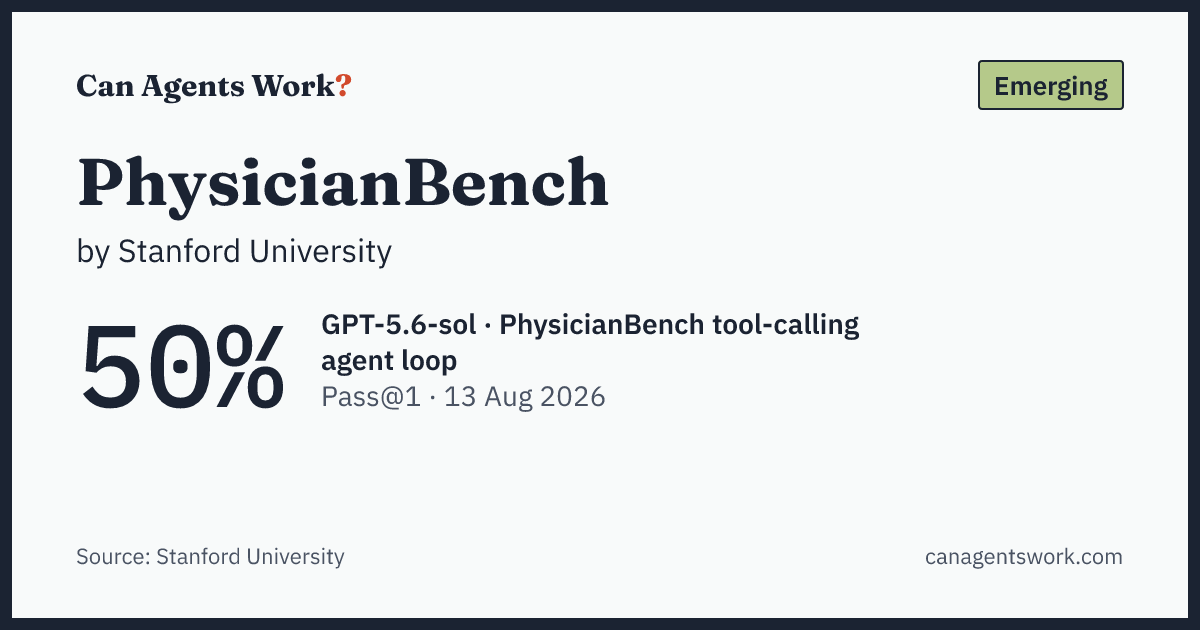
50%
Pass@1
GPT-5.6-sol · harness: PhysicianBench tool-calling agent loop
13 Aug 2026 · Source: Stanford University (benchmark maintainers)
50.0 ± 2.6 (SD over three runs). Pass@3 62.2, Pass^3 31.0, 43.2 tool calls per task. The site shows no date; the row was added to the site's leaderboard data on 2026-08-13 (repository commit "update leaderboard").
The best result is at 20–60% of the ceiling, or at 50–100% of human parity.
What it measures
Pass@1: the share of the 100 tasks fully completed in one attempt, averaged over three independent runs. Each task has 5 to 9 checkpoints (670 in total): FHIR orders are checked against the server state by code, reasoning and documentation by an LLM judge with a clinician-written rubric, and data retrieval by trajectory analysis. A task passes only when every checkpoint passes. The agent uses the benchmark's own tool-calling loop with 14 FHIR search and create tools and at most 100 steps. The leaderboard also reports Pass@3 and Pass^3 (all three runs succeed).
Pass@1: Share of the 100 tasks where every checkpoint passes in a single attempt, mean over three runs. Higher is better.
Status compares the frontier with a ceiling of 100%.
Facts
- Grain
- Task level: bounded tasks with a clear spec
- Environment
- api-tools
- Grading
- state-check, llm-judge, rubric
- Tasks
- 100
- Contamination
- Task instructions and checkpoint graders are public in the repository. The patient data is gated. Every task runs in a fresh container, so no state leaks between runs.
- Reuse
- Code, tasks, and the evaluation harness are Apache 2.0 (repository LICENSE). The patient records ship as a Docker image on Stanford Redivis under a controlled request-and-approval process, governed by the Stanford University Research Data Use Agreement. (cite-only)
Limits to keep in mind
- The patient records are neither fully real nor fully synthetic. The paper says they derive from de-identified Stanford STARR records with added perturbations (date shifts, Faker identities, adjusted clinical values). The README says "real patient records"; the site's methodology section says "a realistic synthetic patient record". Both describe the same perturbed real data. Source
- Reasoning and documentation checkpoints are graded by an LLM judge against a rubric, so part of the score depends on the judge. Source
- One harness only: the maintainers' minimal tool-calling loop. The leaderboard has no dates and no cost figures. All rows are the maintainers' runs. Source
- Reliability is low even at the top: the leader's Pass^3 (all three runs succeed) is 31.0% against a Pass@1 of 50.0%. Source
Recorded results
A selection that shows the frontier over time. The full leaderboard is at the source.
| System | Pass@1 | Date | Source |
|---|---|---|---|
| GPT-5.6-sol · frontier harness: PhysicianBench tool-calling agent loop | 50% | 13 Aug 2026 | Stanford University · primary |
| Claude Opus 4.6 harness: PhysicianBench tool-calling agent loop | 31.7% | 4 May 2026 | Stanford University · primary |
| GPT-5.5 harness: PhysicianBench tool-calling agent loop | 46.3% | 4 May 2026 | Stanford University · primary |
Timeline
Where it sits in the atlas
Work ladder: Direct evidence for Healthcare. On the work ladder it counts as 50% of tasks completed. How the ladder works
Work it measures (O*NET work activities): Collect information about patients or clients; Evaluate patient or client condition or treatment options; Order medical tests or procedures; Prescribe medical treatments or devices; Develop patient or client care or treatment plans.
Go to the source
- Website healthrex.github.io
- Paper arxiv.org
- Full leaderboard healthrex.github.io
- Code github.com
- Dataset stanford.redivis.com
Last checked 24 Sep 2026 against 5 primary sources. See an error? Tell us.
How to cite
Credit the original work first: PhysicianBench by Stanford University (https://arxiv.org/abs/2605.02240).
Then, if you used this page:
Can Agents Work. "PhysicianBench: frontier results and sources." https://canagentswork.com/benchmarks/physicianbench/ (accessed 2026-09-24). CC BY 4.0.@misc{caw-physicianbench,
title = {{PhysicianBench: frontier results and sources}},
author = {{Can Agents Work}},
year = {2026},
howpublished = {\url{https://canagentswork.com/benchmarks/physicianbench/}},
note = {Accessed 2026-09-24. CC BY 4.0}
}