Benchmarks / SWE-bench Verified
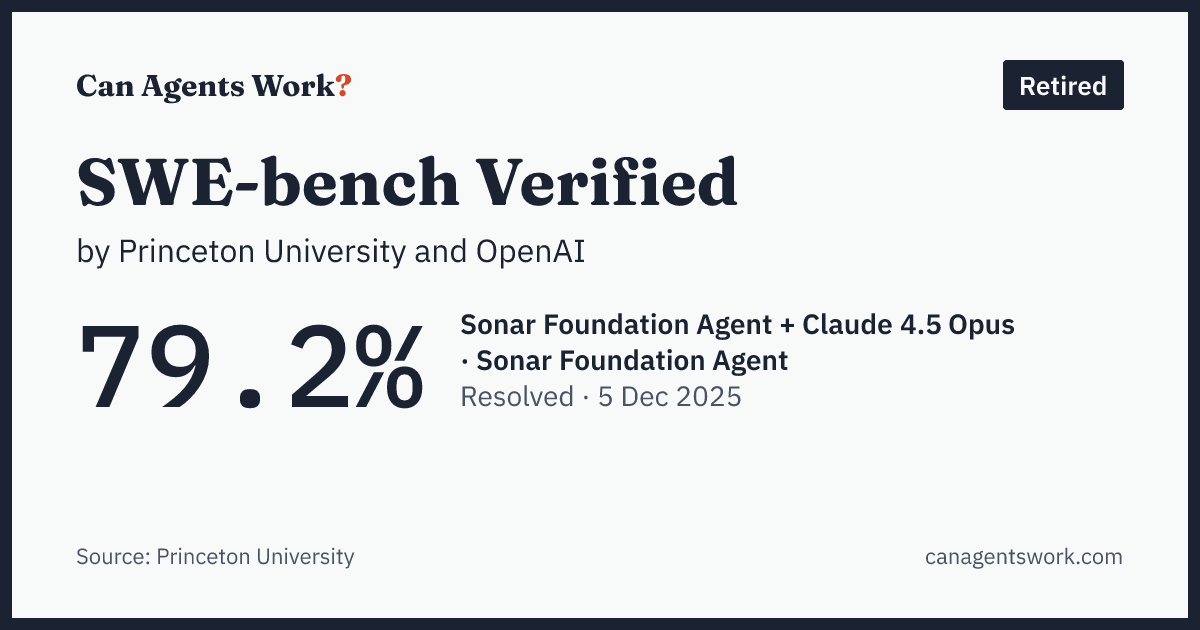
SWE-bench Verified
Built by Princeton University and OpenAI · released 13 Aug 2024
A human-validated subset of 500 SWE-bench tasks. Each task is a real GitHub issue from one of 12 Python repositories. The agent gets the repository and the issue text and must produce a patch. OpenAI and the SWE-bench team built it in 2024 after 93 developers screened 1,699 SWE-bench tasks for unfair tests and vague issue descriptions.
Frontier
79.2%
Resolved
Sonar Foundation Agent + Claude 4.5 Opus · harness: Sonar Foundation Agent · agent: Sonar Foundation Agent
5 Dec 2025 · Source: Princeton University (benchmark maintainers)
Tied at 79.2% with live-SWE-agent + Claude 4.5 Opus (medium), dated 2025-12-15. Neither entry is checked by the SWE-bench team. Single attempt.
Maintainers or a major user stopped using it as a frontier measure.
Retired on 23 Feb 2026: OpenAI stopped reporting SWE-bench Verified on 2026-02-23. Its audit found that at least 59.4% of 138 hard tasks had tests that reject correct solutions, and that all frontier models it probed could reproduce gold patches or problem text from training data. OpenAI told other developers to stop too. The swebench.com leaderboard still exists but has few entries after early 2026. Source.
What it measures
Share of the 500 issues resolved: the patch must make the hidden fail-to-pass tests pass and keep the pass-to-pass tests passing. The official leaderboard accepts submissions from any agent system, so scores mix model quality with scaffold quality. A "Bash Only" view runs every model in the same mini-SWE-agent environment.
Resolved: Percentage of the 500 task instances whose tests pass after the agent's patch is applied. Higher is better.
Status compares the frontier with a ceiling of 100%.
Facts
- Grain
- Task level: bounded tasks with a clear spec
- Environment
- repo, cli
- Grading
- automated-tests
- Tasks
- 500
- Human reference
- Annotators estimated task difficulty by human time. 196 tasks are under 15 minutes, 45 tasks are over 1 hour. No direct human success rate is published.
- Contamination
- High. Tasks and gold patches are public since 2024 and the source repositories are common in training data. OpenAI's red-team probes got GPT-5.2-Chat, Claude Opus 4.5, and Gemini 3 Flash Preview to reproduce gold patches or verbatim task details.
- Reuse
- Task content comes from 12 open-source Python repositories under their own licenses. The SWE-bench harness is MIT. (cite-only)
Limits to keep in mind
- OpenAI's audit of 138 tasks that o3 often failed found 59.4% had material problems: 35.5% had tests tied to one implementation, 18.8% tested behavior not in the issue. Source
- Leaderboard entries use different agents, retry budgets, and model mixes. Most top entries are not checked by the SWE-bench team. Source
- Python only, from 12 repositories, so it does not cover most languages or codebases. Source
Recorded results
A selection that shows the frontier over time. The full leaderboard is at the source.
| System | Resolved | Date | Source |
|---|---|---|---|
| Claude 4.5 Opus (high), mini-SWE-agent harness: mini-SWE-agent | 76.8% | 17 Feb 2026 | Princeton University · primary |
| Sonar Foundation Agent + Claude 4.5 Opus · frontier harness: Sonar Foundation Agent | 79.2% | 5 Dec 2025 | Princeton University · primary |
| TRAE + Claude Sonnet 4 + Opus 4 + Sonnet 3.7 + Gemini 2.5 Pro harness: TRAE | 75.2% | 12 Jun 2025 | Princeton University · primary |
| OpenHands + CodeAct v2.1 (claude-3-5-sonnet-20241022) harness: OpenHands | 53% | 29 Oct 2024 | Princeton University · primary |
| GPT-4o (best open-source scaffold) | 33.2% | 13 Aug 2024 | OpenAI · primary |
Timeline
Where it sits in the atlas
Go to the source
- Website www.swebench.com
- Paper arxiv.org
- Full leaderboard www.swebench.com
- Code github.com
- Announcement openai.com
- Dataset huggingface.co
Last checked 23 Sep 2026 against 5 primary sources. See an error? Tell us.
How to cite
Credit the original work first: SWE-bench Verified by Princeton University and OpenAI (https://arxiv.org/abs/2310.06770).
Then, if you used this page:
Can Agents Work. "SWE-bench Verified: frontier results and sources." https://canagentswork.com/benchmarks/swe-bench-verified/ (accessed 2026-09-24). CC BY 4.0.@misc{caw-swe-bench-verified,
title = {{SWE-bench Verified: frontier results and sources}},
author = {{Can Agents Work}},
year = {2026},
howpublished = {\url{https://canagentswork.com/benchmarks/swe-bench-verified/}},
note = {Accessed 2026-09-24. CC BY 4.0}
}