Jobs / ML and research engineering
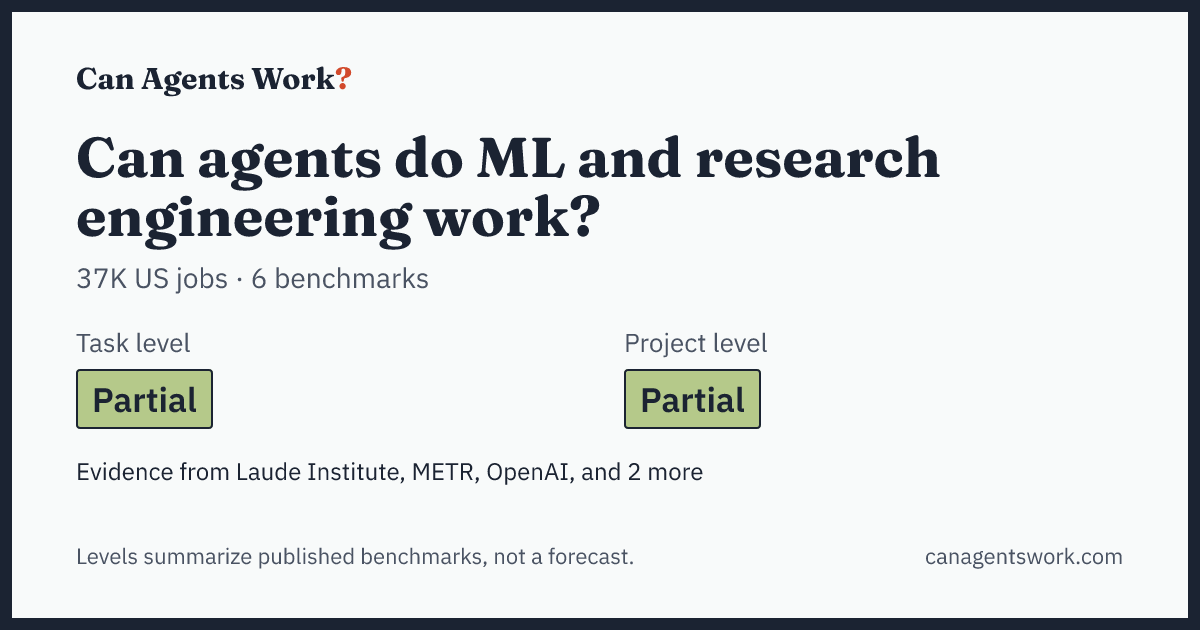
Can agents do ML and research engineering work?
Train and evaluate models, run experiments, and reproduce research.
- US jobs
- 37,200 (0.0% of employment)
- Typical wage
- $140K a year (employment-weighted mean of occupation medians)
- Occupations
- 1 in O*NET 31.0
- Evidence
- 3 direct benchmarks, 3 also relevant, 1 context only
The answer today
Some tasksNo change since 10 Oct 2025.
Rule: Agents complete 20% or more of the tasks (or projects) on a direct benchmark.
The evidence that sets this step
- MLE-bench by OpenAI: 64.4% of projects completed · Famou-Agent 2.0 (Gemini-3-Pro-Preview), 23 Feb 2026
Next step: Most tasks needs 60% or more of the tasks (or projects) on two direct benchmarks from independent institutions.
How much of the work is measured
23% of the work in this family is measured by direct benchmarks. Some of the work is measured (20% to 50%). On 10 Oct 2025: 23%.
Work = the O*NET 31.0 work activities of the family's occupations, weighted by how important each task is and by US employment. A benchmark measures an activity when its tasks make the agent do it and its grading checks it. Method.
| Work activity (O*NET) | Share of the work | Direct benchmark |
|---|---|---|
| Design computer or information systems or applications | 15.1% | Measured |
| Analyze data to improve operations | 10.0% | Not measured |
| Analyze scientific or applied data using mathematical principles | 8.2% | Measured |
| Coordinate with others to resolve problems | 7.8% | Not measured |
| Assign work to others | 7.6% | Not measured |
| Evaluate project feasibility | 7.0% | Not measured |
| Communicate with others about specifications or project details | 7.0% | Not measured |
| Develop technical specifications for products or operations | 6.0% | Not measured |
| Assist scientists, scholars, or technical specialists with projects or research | 6.0% | Not measured |
| Develop organizational or program goals or objectives | 5.9% | Not measured |
Our reading
Agents complete some ML engineering work. On MLE-bench, 75 offline Kaggle competitions, the best agent earns a medal in 64.44% of competitions with 24 hours each; OpenAI closed the leaderboard to new entries in April 2026. MLE-bench is a project benchmark, but the ladder needs two from independent institutions for some projects. Other direct evidence gives partial credit, not a completion rate, and is old: 26% on PaperBench, replication of ML papers (o1, April 2025), and the 37th percentile of human experts at 8 hours on RE-Bench (January 2025). No direct benchmark measures analyzing data to improve operations, assigning work, or evaluating project feasibility.
Evidence: MLE-bench, PaperBench, RE-Bench by METR and OpenAI. Written 24 Sep 2026.
Benchmarks for this work
Direct evidence
Work benchmarks mapped primary to this family. They set the step when they report how many tasks agents complete.
Also relevant
These benchmarks cover part of this family's work, or have no result yet. They do not set its step.
- 95.5%Claude Code + Claude Opus 4.5 (after manual regrading) · 3 Dec 2025Solved
- 84.7%NexAU-AHE + GPT-5.5 · 23 Apr 2026Retired
- 64.8%Claude Code + Opus 5.5 (max) · 6 Oct 2026Strong
Context only
These benchmarks span many occupations, or they test how agents behave. They give context but do not set the step.
Functions: Research replicationLong-horizon autonomyML engineeringAutonomous R&DPerformance engineeringTerminal operationsFeature development
What we do not know
- Benchmarks measure tasks, not whole jobs. A job is a bundle of tasks, judgment, and relationships.
- Capability is not adoption. A task that agents can do in a benchmark may still be done by people at work.
- Most results come from single runs. Reliability over many runs is often unknown.
Occupations in this family
Sorted by US employment (BLS OEWS May 2025). O*NET sub-occupations share the employment figure of their SOC group. Work measured = the share of the occupation's O*NET work that direct benchmarks test.
| Occupation | SOC | US jobs | Work measured |
|---|---|---|---|
| Computer and Information Research Scientists | 15-1221.00 | 37K | 23% |
How to cite
Credit the original work first: the benchmarks listed on this page, and their institutions.
Then, if you used this page:
Can Agents Work. "Can agents do ML and research engineering work?." https://canagentswork.com/jobs/ml-research-engineering/ (accessed 2026-10-11). CC BY 4.0.@misc{caw-jobs-ml-research-engineering,
title = {{Can agents do ML and research engineering work?}},
author = {{Can Agents Work}},
year = {2026},
howpublished = {\url{https://canagentswork.com/jobs/ml-research-engineering/}},
note = {Accessed 2026-10-11. CC BY 4.0}
}